Leyendo por Internet encontré un artículo muy interesante sobre una gran iniciativa que veo crecer en Sevilla, sobre todo en el centro. Os dejo el enlace y la traducción de un fragmento al inglés, para que los que no sepan español.
While browsing some websites I found an interesting article about a great and growing initiative in Seville, specially in the city center. I post the link and an English translation for the non- Spanish speakers.
Bartering
and time banking, the new antidotes against the Spanish crisis
When there
is no work, time is gold. To be precise, money. This is the premise
that supports the philosophy of a growing branch of Spanish
youngsters. In the middle of an economical crisis which burst already
five years ago, and brought to Spain the highest unemployment rate in
all industrialized countries, there are lots of young people in our
country supporting initiatives to fight the hard austerity measures
imposed by Mariano Rajoy's government.
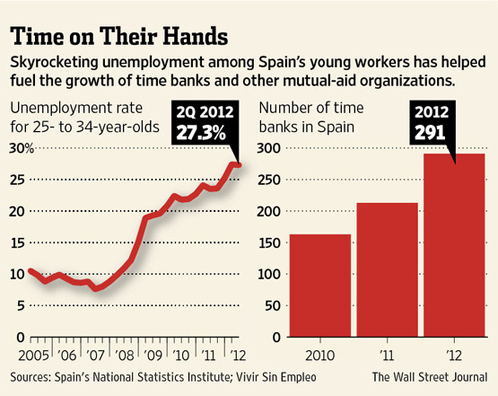
It is
getting more and more usual to find young people, aged between 20 and
35, with no job, no car, no mortgage and no trusted bank. According
to The Wall Street Journal, the consequence is the birth of
initiatives such as a “time bank” in the city of Valladolid,
which is not a traditional financial institution but an institution
where “mutual-aid” services are exchanged within a certain
community on an hourly basis. So simple is it. They exchange
cleaning services, transportation, cooking, home repair, babysitting
or elderly care. Whatever one needs.
This new
philosophy includes not only time banking, but also other
manifestations which distance from our formal economy principles and
have blossomed in the last years as a survival strategy. Bartering
markets, or the creation of local currency such as the Eco
in Alt Congost (Barcelona) or the Puma, from El
Pumarejo (Seville). The shared vegetable gardens are spread
virtually all over the country. The main reason for the these
alternatives' emergence is the distrust in the Euro and the
regulatory authorities.
According
to The Wall Street Journal, the amount of alternative banks in Spain-
some of them managed by neighbor associations or even by local
governments- has increased to 291 in only two years, according to a
survey carried out by the platform “Vivir
sin empleo”. Many
economists show their concern towards the possibility of these
“informal systems” spread and fear that the new initiatives, out
of the view of regulators and tax collectors, will dash the recovery
of Spanish economy.

No hay comentarios:
Publicar un comentario