martes, 11 de diciembre de 2012

Buscar trabajo en el extranjero: la traducción del CV

Creo que en los tiempos que corren, todo el mundo conoce a alguien, directa o indirectamente, que se ha ido a buscar trabajo al extranjero, tal y como están las cosas por aquí.


Cuando se toma la decisión, hay muchas cosas que hay que tener en cuenta: el idioma, las posibilidades laborales, el reconocimiento de los títulos académicos, trámites burocráticos como permisos de residencia o de trabajo... demasiadas como para ponerlas todas en un post. Pero una vez resueltas, y ya centrados en el país de destino, llega el momento de ponerse a mandar el CV.

Es conveniente saber que traducir nuestro CV del español al idioma del país al que vamos a emigrar no suele ser suficiente. Probablemente haya que adaptarlo al formato que se suele utilizar en ese país. También hay que tener en cuenta que cosas como poner la foto en el CV pueden variar mucho de un país a otro: en algunos países se considera conveniente, mientras que en otros se considera totalmente inadecuado.

Y al hacer la traducción, hay que tener en cuenta que al hablar de los puestos laborales que se han ocupado puede ser necesario dar una explicación, ya que las categorías laborales pueden ser diferentes de un país a otro. O que para traducir un giro de palabras puede ser que no valga una traducción literal de cada palabra que lo compone (por ejemplo, en holandés arts-assistent in opleiding por el español médico interno residente).

Y por último, tener en cuenta las variedades del idioma según el país a donde enviamos nuestro CV. Por ejemplo, si mandamos nuestro CV al Reino Unido nos referiremos a él como CV o curriculum vitae mientras que si lo dirigimos a Estados Unidos lo llamaremos resume. Al escribir debemos tener además en cuenta otras variaciones entre el inglés británico y el inglés americano como la ortografía, el vocabulario, cuestiones gramaticales, etc.

Eso sí, mandar un CV sin errores de forma, de estilo, de ortografía y de gramática es fundamental para conseguir un trabajo. Por ello, puede ser conveniente dejar que nos lo revise un traductor para asegurarnos que el texto es correcto.

miércoles, 5 de diciembre de 2012

Alergias alimentarias- Food allergies


I found an interesting (and reliable) article about food allergies on the web, I share the link to the whole article in this post and leave a Spanish translation of an excerpt.

He encontrado en la red un artículo interesante (y fiable) en inglés sobre las alergias alimentarias, os dejo el enlace y la traducción al español de un fragmento.

Alergias alimentarias

    Autores: Scott H Sicherer, MD; Chief Editor: Michael A Kaliner, MD
    Publicado en http://emedicine.medscape.com/article/135959-overview
Las alergias alimentarias son reacciones adversas a los alimentos mediadas por el sistema inmune. Dichas alergias pueden resultar en trastornos de instauración aguda tras la ingestión del alergeno alimentario desencadenante (por ejemplo, anafilaxia) así como trastornos crónicos (por ejemplo, dermatitis atópica). Los síntomas observados en una reacción anafiláctica inducida por alimentos pueden comprometer a la piel, el tracto gastrointestinal y el tracto respiratorio. (Ver fisiopatología, etiología y presentación.)
Cualquier proteína alimentaria puede desencadenar una respuesta alérgica, y han sido documentadas reacciones alérgicas a un gran número de alimentos; sin embargo, solo un número reducido de alimentos es responsable de estas reacciones. Los huevos, la leche, los cacahuetes, la soja, el pescado, los mariscos, los frutos secos y el trigo son los alimentos que con más frecuencia se ven implicados en reacciones alérgicas confirmadas en ensayo ciego controlado (con supervisión médica e ingestiones graduales.) El sésamo parece ser un alergeno emergente (Ver etiología y pruebas diagnósticas).
La investigación sobre reacciones anafilácticas fatales o casi fatales siguientes a la ingestión de alimentos revelan que la mayoría son causadas por cacahuetes, frutos secos y mariscos, aunque también aumentan las reacciones atribuidas a la leche. (Ver pruebas diagnósticas).
Las reacciones adversas a los alimentos no mediadas por el sistema inmune no son consideradas alergias alimentarias. Un ejemplo es la intolerancia a la lactosa, que es causada por un déficit de lactasa. Las reacciones adversas a los alimentos pueden ser desencadenadas también por efectos tóxicos (por ejemplo, intoxicación bacteriana de los alimentos) o farmacológicos (por ejemplo, la cafeína).


http://emedicine.medscape.com/article/135959-overview

jueves, 29 de noviembre de 2012

Trueque y bancos del tiempo

Leyendo por Internet encontré un artículo muy interesante sobre una gran iniciativa que veo crecer en Sevilla, sobre todo en el centro. Os dejo el enlace y la traducción de un fragmento al inglés, para que los que no sepan español.
While browsing some websites I found an interesting article about a great and growing initiative in Seville, specially in the city center. I post the link and an English translation for the non- Spanish speakers.


Bartering and time banking, the new antidotes against the Spanish crisis

When there is no work, time is gold. To be precise, money. This is the premise that supports the philosophy of a growing branch of Spanish youngsters. In the middle of an economical crisis which burst already five years ago, and brought to Spain the highest unemployment rate in all industrialized countries, there are lots of young people in our country supporting initiatives to fight the hard austerity measures imposed by Mariano Rajoy's government.


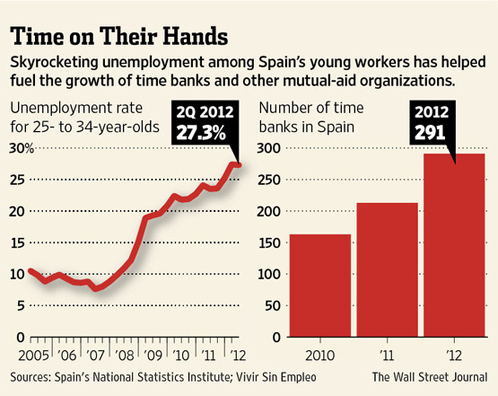
It is getting more and more usual to find young people, aged between 20 and 35, with no job, no car, no mortgage and no trusted bank. According to The Wall Street Journal, the consequence is the birth of initiatives such as a “time bank” in the city of Valladolid, which is not a traditional financial institution but an institution where “mutual-aid” services are exchanged within a certain community on an hourly basis. So simple is it. They exchange cleaning services, transportation, cooking, home repair, babysitting or elderly care. Whatever one needs.

This new philosophy includes not only time banking, but also other manifestations which distance from our formal economy principles and have blossomed in the last years as a survival strategy. Bartering markets, or the creation of local currency such as the Eco in Alt Congost (Barcelona) or the Puma, from El Pumarejo (Seville). The shared vegetable gardens are spread virtually all over the country. The main reason for the these alternatives' emergence is the distrust in the Euro and the regulatory authorities.

According to The Wall Street Journal, the amount of alternative banks in Spain- some of them managed by neighbor associations or even by local governments- has increased to 291 in only two years, according to a survey carried out by the platform “Vivir sin empleo”. Many economists show their concern towards the possibility of these “informal systems” spread and fear that the new initiatives, out of the view of regulators and tax collectors, will dash the recovery of Spanish economy.

miércoles, 21 de noviembre de 2012

Bajón otoñal

En estos días grises , en los que oscurece pronto, me siento más cansada. Leyendo entre los artículos de Trouw.nl encontré este que me llamó la atención: Herfstdipje? Misschien knapt u op van spiritualiteit. Os dejo la traducción.

http://www.trouw.nl/tr/nl/5097/Spiritualiteit/article/detail/3326004/2012/10/03/Herfstdipje-Misschien-knapt-u-op-van-spiritualiteit.dhtml


¿Bajón otoñal? Quizá le ayude la espiritualidad
Por Robin de Wever − 03/10/12, 12:59

Quien tiene un mal día puede beneficiarse de la oración o de la meditación. Las personas “espiritualmente activas” mejoran con ello, según psicólogos americanos.


Las personas que practican la espiritualidad tienen más emociones positivas, una auto-imagen mejor y ven la vida de forma más optimista. La oración y la meditación obtienen pocos resultados positivos en personas con poca afinidad por la espiritualidad. Si durante un bajón buscan contacto con una fuerza superior, se sentirán quizás incluso peor.
Estas son al menos las conclusiones del grupo de investigación del psicólogo Todd Kashdan de la Universidad George Mason de la ciudad de Virginia (Estados Unidos). Kashdan realizó su investigación a través de unos diarios en los que 87 estudiantes de diferentes creencias religiosas registraron durante más de tres años su estado de ánimo y su actividad espiritual.

El efecto positivo global se conoce desde hace tiempo
“Sus efectos son significativos”, publica Kashdan en la revista científica Personality and Social Psychology Bulletin. Que la oración y la meditación pueden tener efecto positivo en nuestro bienestar se conoce desde hace tiempo. Una investigación anterior sacó en conclusión que las personas espiritualmente activas se siente felices con frecuencia. Las mujeres de esta categoría serían incluso sexualmente más activas.
Según Kashdan los resultados demuestran que tales efectos no solo son visibles a largo plazo. La espiritualidad también puede aportar alivio temporal.

martes, 13 de noviembre de 2012

Oleada de despidos en Europa

La noticia original apareció publicada en el peródico holandés NRC el 8 de noviembre de 2012.
http://www.nrc.nl/carriere/2012/11/08/ontslaggolf-in-europa-30-000-banen-verdwijnen/
Os dejo la traducción. Es escalofriante pensar que se destruye empleo de forma masiva y por toda Europa.


Por Alex van der Hulst

Oleada de despidos en Europa, desaparecen 30.000 puestos de trabajo

Es la hora de la verdad en Europa. ING anunció ayer la supresión de 2350 puestos de trabajo. Heijmans elimina hoy 200 y en el resto de Europa se ha anunciado esta semana que en total desaparecerán 30.000 empleos.
BNR enumera la oleada de despidos de esta semana. Además de la noticia de ayer de ING y el comunicado de Heijmans de hoy, desparecen en el resto de Europa además unos 30.000 puestos de trabajo.

Iberia
La aerolínea española Iberia da el golpe más duro, ya que 7000 puestos de trabajo desaparecerán tras su fusión con British Airways, según los sindicatos.

Problemas de salud
La planta de siderurgia italiana Ilva ha anunciado la supresión de 2000 puestos de trabajo, dado que la empresa se ve presionada a causa de los problemas de salud de los habitantes de la zona donde tienen sus fábricas.

Commerzbank
El Commerzbank alemán despide al 10% de sus empleados, es decir, entre 5000 y 6000 empleados de banca, según el periódico semanal alemán Die Zeit. Además, desparecen en Alemania 1800 puestos de trabajo de la fábrica de acero Klöckner.
La empresa de telecomunicaciones irlandesa Eircom sufre bajo una deuda de 3,5 millones de euros y despide a 2000 trabajadores.

Sector del automóvil
En el sector del automóvil desaparecen muchos puestos de trabajo. Ford había anunciado previamente varios despidos. General Motors quiere eliminar 2500 empleos en Europa y Volvo suprime 300 puestos de trabajo.

España
Suzuki despide a 200 trabajadores y el fabricante de neumáticos Bridgestone a 400, ambos en España. La empresa aeronáutica canadiense Bombardier suprime 1200 puestos de trabajo en Alemania dentro de un plan de recortes.

Suecia
La empresa de energía eólica Vestas suprime 2000 puestos. En Suecia tampoco van las cosas bien para Sony Ericsson (1550 empleos) ni para Husqvarna (600 puestos), en una oleada de despidos.

Todo sumado nos lleva a 30.000 despidos en Europa en cuestión de unos días.


domingo, 11 de noviembre de 2012

Chapuzas de traducción

Los menús de los restaurantes pueden ofrecer, además de platos apetitosos, errores graves cuando los traducen a otros idiomas (¿quién hará esas traducciones?). Este me ha llamado la atención por su "coup of whine", que hizo que me parase a leer el resto y decidiese hacer la foto.


Por si a alguien le quedan dudas:

Meal of the day y no the meal of day
Garlic y no garlick
Chicken soup y no chicken's soup (digo yo que el pollo ni hace sopa ni la come)
Pork steak y no steak of pork
Grilled chicken y no grill chicken
Cup of wine y no coup of whine 
Dessert y no desert (a no ser que se refieran a que antes de pagar te vayas corriendo porque el vino era tan malo que hacía llorar)

domingo, 4 de noviembre de 2012

Preparar el examen de traductor jurado

Aunque este año no está claro si va a haber convocatoria de exámenes de traductor jurado, he estado buscando información sobre la preparación de las pruebas. Esta es la página más útil que he encontrado, con información relevante y bien estructurada.


http://traduccion-jurada-oficial.blogspot.com.es/2012/03/cursos-de-preparacion-del-examen-de.html?utm_source=feedburner&utm_medium=feed&utm_campaign=Feed:+traductor-jurado+%28Traductor+Jurado%29

domingo, 7 de octubre de 2012

Cómo tratar con los clientes

 Una serie de consejos sobre cómo tratar con agencias de traducción y clientes, publicado por translatorscafe.com

http://www.translatorscafe.com/tcterms/help/?ctg=C&HelpID=56

Dealing with Agencies and Direct Clients

Here are a few tips for dealing with direct clients and translation agencies (based on personal experience and accounts of colleagues):

  1. Always get your client to sign a Purchase Order. A written confirmation by fax or e-mail will do the trick in most jurisdictions.
  2. If the agency requires you to sign a contract for subcontractors, read it carefully. If there is only the slightest doubt in your mind, don't sign it. One example of a “delicate” clause that some agencies use is the “time of payment clause”, as I call it: in it, the agency states that the translator will get paid once the agency has received payment from its end client. Under contract law, this is completely wrong and should not be signed by any professional translator. As a matter of fact, this “transaction” involves two contracts: one between the agency and its client and another contract between the agency and the freelance translator. The latter is completely independent of the former, and whether or not the end client ever pays the agency is of no concern to the translator. In other words, the agency has to pay the translator according to the contract between them, even if the end client defaults on its payment to the agency. Therefore, withholding payment until payment has come in from the end client is highly unethical and violates contract law.
  3. “Train” your clients: explain to them, in simple language if necessary, what translation is all about. Do not accept any unrealistic demands from them (eg, 5,000 words within 24 hours). Many people out there still believe that translation involves nothing more than replacing words of language A with words of language B. Emphasize that the translation of 1,000 words usually takes longer than writing those same 1,000 words.
  4. Be strict about your terms of payment: upon initial contact with the agency (or direct client), explain your terms to them. Be polite, yet firm. Inform them that they will be subject to late-payment interest if they don't pay within the period of time stipulated. Remember: it is the seller (= YOU) who sets out the terms of payment, not the buyer. When you go into a store or order something online, you have to abide by the seller’s terms and not your own. Most agencies will pay you within 30 days, but there are some, especially in the Benelux countries, that define payment terms of 45, 60 or more days. Explain to them that the seller defines those terms and not the buyer.
  5. Sometimes, an agency may tell you that they cannot pay you on time because of cash flow problems—that is, after you have already sent them several reminders for payment. ALARM BELLS! This means: a) they have lousy clients themselves that don't pay them (which is not exactly a ringing endorsement of the agency and its business acumen); b) their management is really sloppy; c) they are not professional; AND d) things can only go downhill from there ==> so stop accepting any new jobs from them; tell them that you may consider working for them again if and when you have been paid and if and when they have set their house in order.
  6. If you do get into trouble with an agency, again, be firm. Inform them that you will have to charge late-payment interest and that they will also be responsible for any legal or collection fees you may incur in the process. You may also want to point out to them that you will post information about their payment practices to several payment practices lists.
  7. Avoid any agencies that post jobs on the Internet or contact you by e-mail but fail to give detailed background information on themselves (phone number, mailing address, etc.).
  8. Avoid clients that use free e-mail accounts such as Hotmail or Yahoo—if an agency uses such accounts, you can rest assured that they are not legit and professional. A professional agency can afford either its own server or a professional hosting service.
  9. Avoid agencies that require an excessive number of words to be translated by way of a "test"—it could be a way for them to have a document translated for free. Remember: standard translation tests should not exceed 200-250 words.
  10. Regarding tests: even if the sample is only 200-250 words in length, make sure it is a self-contained text; otherwise, it might be that they are sending out small portions of a larger text to a number of translators as "tests"—again, for the purposes of getting the translation for free.
  11. Beware of UNSOLICITED e-mails you receive from agencies ("we have recently come across your name and would like to invite you to join our team of translators. Please send us your CV, rates, client list, etc.")—this is often a trick to “scan” the competition (they want to know who your clients are), so if you provide them with 2 or 3 professional references, they will contact them, not to verify your work, but to solicit business from your clients!
  12. Regarding references: never, under any circumstances, give out references. Giving out 2 or 3 references is common practice when applying for a permanent position, but as freelancers we cannot do that: we are legally and ethically bound to keep any and all information regarding our clients confidential. Therefore, suggest to the agency that they could send you either a 200-word test or a small job for which they would have to pay you a minimum fee (“the proof of the pudding is in the eating”). This way, the agency does not take on too much risk and you would not have to breach your clients' confidentiality. Remember: when you see a new doctor, you cannot ask the doctor for his/her patient list either!!!
  13. It is always better to forgo a potential job (in case of any doubt about the client) than to go through the hassle and headaches of chasing after your money later on.
  14. Stay away from “telemarketers”: if you receive a phone call from an agency, and that person talks as fast as a telemarketer or used-car salesperson and does the whole “sales-pitch dance” (even though that person may strike you as being very personable), be polite and end the conversation as quickly as possible, because, in all probability, no good will come of this conversation anyway.
  15. For larger projects, charge a “retainer”, or down payment, of about 25%. Demand to be paid in various stages as the project moves along. Don't beat about the bush: tell your client that you will still have to feed and clothe yourself for the duration of the project (e.g., 2 months)—and that you will not be available to other, regular, clients for the duration of this project, for which you need to be compensated. For example, 25% upfront, another 25% halfway through the project and the remainder upon completion of the project.
  16. Speaking of “retainer”: Do not be afraid to charge new clients upfront. Depending on the volume of their first job, you may require as much as 100% to be paid in advance. Credit is a privilege, not a right, that must be earned. Asking for payment upfront is the best way to separate the "wheat from the chaff"—or, put differently, to separate the crooks from the honest ones.
  17. If a client asks you to acquire special software or any other product (as a requirement for receiving work), please check and double-check the facts before you agree to anything. In most cases, these people are not real clients, but merely “telemarketers” or scam artists trying to sell some useless software, product, etc. Remember: as a professional translator, you should never have to *PAY* your own clients .... that would be ridiculous and insane, wouldn't it?
  18. Never, under any circumstances, accept work sight unseen. When an agency has a rather difficult or unpleasant project, they will either call you or send you an e-mail without any attachments. The idea is to get you to agree to handle the job without having had a chance to take a look at it. Some agencies pull this stunt with unsurprising regularity around 4 or 5 PM on Friday afternoons. “It’s an urgent job, and we need it ASAP, but no later than Monday morning.” Something like that gets really “fishy” if the call comes from an agency you have never worked with before. Fishy because no professional agency would ever hand an urgent and important job to an untested translator. This can mean only thing: they are trying to set you up and have no intention of ever paying you. In cases where you do know the agency, different motives come into play: they know that most translators would not want to handle the file because the file format is awkward (e.g., source text is available as a hardcopy or, worse, fax copy only) or because it is a generally difficult text. By just “cold-calling” you, they hope you will give them a quote and agree to do it just like that (“Hey, that agency is calling me. Man, that makes me feel really important! Can’t say no now!”). Then you receive the file and have the shock of your life.
  19. Volumes: In Europe, many translation agencies go by the following standards: 1,000 words a day (normal volume) and 2,000 words (express/rush). Personally, I believe that any professional should be able to handle 2,000 words a day, and 2,000 words is the standard most commonly applied. Never agree to any volumes that you cannot handle.
  20. Always deliver on time or ahead of schedule. This will not only ensure repeat business; it is also the professional thing to do. Too many translators today deliver late—sometimes as much as 48 hours after the deadline has passed. Tardiness is a growing “disease” in our profession these days, and many clients are already painfully aware of this trend. So, by delivering on time or early, you can score some major "brownie points".
Werner Patels

sábado, 6 de octubre de 2012

A la luz de la luna

Me gustan la palabra moonlighthing y su derivado moonlighter mucho más que sus traducciones, pluriempleo o pluriempleado. Si bien las dos reflejan la realidad de desempeñar dos trabajos o más y por ello muchas veces tener que hacerlo de noche, el término moonlighthing me hace pensar en la parte más romántica de esa realidad, en la de trabajar con afán bajo la luz de la luna mientras se espera que se cumplan nuestros sueños y proyectos.

viernes, 5 de octubre de 2012

Una de false friends

Historieta para ilustrar los típicos false friends
más historias en http://www.bbc.co.uk/languages/yoursay/false_friends.shtml


Bird flu (English/Spanish)

http://www.bbc.co.uk/languages/yoursay/false_friends/spanish/bird_flu_englishspanish.shtml


http://blog.castello.es/index.php?blog=111&title=grip_o_catarro_catarro_o_grip_fruita_del&more=1&c=1&tb=1&pb=1

Watch out when using the words cotorra and catarro in Mexico. Cotorra refers to a type of parrot, while catarro refers to a cold or the runny nose symptoms of one. I once confounded a pharmacy employee in a futile attempt to describe to him that I had serious 'parrot symptoms.' He recommended that I consult a veterinarinan until I made it clear that it was me that was sick.